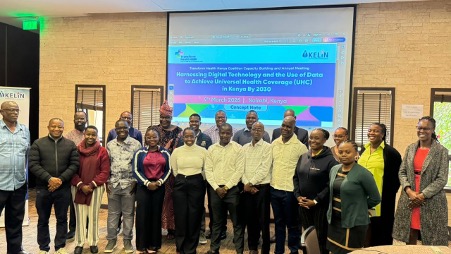
On 5th and 6th March 2026, health experts, prison officials, lawyers, and community advocates gathered in Naivasha for the National Advocacy Forum on Drug-Resistant Tuberculosis (DR-TB) under the COMBAT DR-TB project. At the heart of the conversation was a simple but urgent question: should a person’s chances of surviving TB depend on whether they are free or behind bars? What emerged from the convening was not just a technical discussion – but a moral reckoning -one where the stakeholders refused to look away from one of Kenya’s most overlooked public health crises.
Hosted by KELIN in partnership with the Kenya Prisons Service and the National TB and Leprosy Programme, the forum brought together 23 participants over two days united by a shared commitment—to ensure that health justice does not stop at the prison gate. .
The conversation was long overdue. Tuberculosis remains one of Kenya’s most pressing public health challenges. The burden is even more severe in Kenya’s prisons which are notably among the highest-risk settings for TB in the country. Overcrowded cells, poor ventilation, and overstretched health services create the perfect conditions for the disease to spread, and for cases to go undetected for far too long. Furthermore, when inmates are transferred between facilities or released back into their communities, treatment is often interrupted, records are lost, and the disease moves with them. This reality reframes the issue: prison health is public health. Protecting the health of incarcerated persons is not only a human rights obligation—it is a societal imperative.
The advocacy forum offered an honest reflection on what is still missing. Participants examined the policy gaps that have slowed progress for too long. Currently, there is no TB policy specifically designed for Kenya’s prisons. As a result, there are no enforceable standards for screening, no clear procedures governing inmate transfers, and no formal handover process to ensure continuity of care when someone is released.
What made the forum particularly meaningful was not only the identification of these challenges but the shared commitment to move forward. Participants discussed the gaps openly, challenged one another’s perspectives, and left with a clearer understanding of what must change.
The strongest recommendation to emerge from the two days was the immediate need to develop a dedicated TB policy for the Kenya Prisons Service, one tailored to the realities of correctional facilities. Such a policy would:
- Establish enforceable standards for screening and diagnosis
- Strengthen infection prevention and control
- Ensure continuity of treatment during transfers and after release
- Integrate prison health systems into national TB responses
- Centre dignity, rights, and equity for both inmates and prison staff
Ultimately, TB treatment does not stop at the prison gate. Incarceration does not erase the right to health. The Constitution of Kenya (2010) guarantees every person the highest attainable standard of health—without exception. Yet in practice, those behind bars remain among the most excluded from health systems. The people inside those walls are part of our families, our communities, and our shared future. Health justice therefore demands more. It calls on us to confront the structural inequalities that allow disease to thrive in places of detention. Securing the right to health for them —is not only protecting them but safeguarding us all.
For more information, please contact:
Ibrahim Kimani
Program officer – HIV/TB wainainakimani@kelinkenya.org
KELIN
Kuwinda Lane, Karen C, off Langáta Road