At the International Conference on AIDS and STIs in Africa (ICASA) in Accra last week, under the theme “Africa in Action: Catalysing Integrated Sustainable Responses to End AIDS, TB & Malaria,” the Kenya Community Advisory Team (K-CAT) joined the Digital Health & Rights Project (DHRP) delegation and brought a youth-led, community-centered lens to the heart of the digital health debate, data governance and dignity. ICASA’s programme emphasized integrated, people-centered responses and the role of digital technologies in strengthening health systems, making it the right forum to surface the DHRP findings and the real, everyday concerns of young people when health systems go digital without embedding rights. For KCAT, it was an opportunity to demonstrate why youth leadership needs to shape digital health decisions, rather than merely inform them.
What we shared and why it matters
We ran a Thursday morning session to present results from the Kenya/Ghana arm of the DHRP study, joined by colleagues from the Ghana Community Advisory Team, colleagues from Warwick University. Our presentation translated research evidence into lived stories: how platforms and data systems can help link young people to care, and how the same systems can expose them to stigma, surveillance or harm.
These conversations echoed a central theme: digital health cannot succeed on trust alone. It needs protection. And it needs young people to help define what safe, trusted systems look like in practice.
The “Cost of Connection”: Beyond Data Bundle
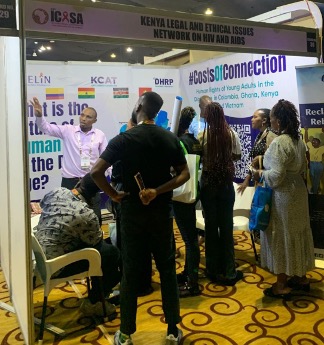
Over the course of three days at the booth, the DHRP space transformed into a hub for dialogue, contemplation, and connection. Conference delegates and the community kept coming back for discussions that extended beyond the formal presentations. Alongside young people, researchers, community advocates and activists, and policymakers, we delved into the realities of navigating digital health systems today.
We explored the notion of the “cost of connection,” not just the costs of devices and data, but also the emotional and social risks that young people face when seeking HIV or SRHR information online.
Young people recounted personal experiences that highlighted the research’s relevance:
- Utilizing shared phones where private searches can be easily revealed
- Being subject to monitoring by partners or parents
- Encountering threats, blackmail, or being “outed” through screenshots and metadata
- Disrupting care due to unreliable internet connections or costly data bundles
These discussions were far from abstract; they were genuine reflections that influenced how delegates perceived digital inequality. Working alongside the Ghana CAT at the booth, it became evident that many of these problems were common across contexts, with both teams raising shared concerns about digital literacy gaps, exposure risks and the need for youth-led oversight across borders. The overlap strengthened our message that digital rights challenges are regional, not isolated.
Joy as Advocacy: Building a Welcoming Space
Following these deeper conversations, another layer of engagement emerged, music, dance, laughter, and moments of cultural connection. This created a space for people to relax. It made the environment welcoming. It served as a reminder that advocacy can encompass both joy and critique, and that young people excel in both areas. It confirmed that safe spaces are emotional as well as intellectual, allowing people to connect as people before interacting as experts.
Our poster — bringing youth evidence into the ICASA spotlight
We also presented our poster, “Bridging Digital Divides for HIV and SRHR: Youth-Informed Strategies for Strengthening Kenya’s Health System.” It highlighted the primary challenges that young people face including limited digital access, high data costs, low digital literacy, privacy worries, and technology-facilitated abuse alongside youth-led strategies that build trust and safety.
Many delegates noted that the poster effectively anchored high-level policy discussions in the real experiences of young people who seek online health information through shared devices, unreliable networks, or applications that do not guarantee confidentiality. It served as a practical starting point for dialogues about why digital transformation should prioritize rights and safety. For KCAT, the poster functioned as a tool for both evidence and advocacy, a proof that youth-led findings can shape national and regional conversations. While the poster allowed for deep dives, another format at the conference highlighted the persistent challenge of tokenistic inclusion.
The podcast and a missed opportunity for meaningful youth engagement
One moment that stood out was a scheduled live podcast for 45 minutes hosted by the Ghana CAT, which was unexpectedly reduced to 10 minutes. While it seemed like a logistical problem at first glance, it highlighted a recurring trend: youth discussions are often condensed into brief snippets. Young people should not be required to condense their complex experiences into a few rushed minutes.
Meaningful participation requires time. Time to reflect, to explain how stigma, technology and gendered harm intersect, and to shape recommendations rather than respond on cue. This experience served as a reminder that conferences need to align their professed commitment to people-centered approaches with genuine opportunities for young people to take the lead.
How ICASA conversations shaped the HIV/SRHR debate
Four key themes emerged at ICASA, nudging the HIV/SRHR conversation forward including:
- The growing need to marry digital health tools to legal protections, transparent consent, and active community oversight.
- Young people and PLHIV networks must be positioned as co-designers and watchdogs of digital systems, not just as passive users, to ensure both uptake and safety.
- Online abuse uniquely affects young women’s SRHR access and autonomy, calling for safety-by-design and reporting channels that are accessible and protective.
- Findings from participatory research, like the DHRP findings, should inform national policies and digital governance frameworks.
The message was clear: digital health must become rights-led, not technology-led.
A simple, urgent ask
From the K-CAT’s perspective the path forward is clear and practical:
- Design digital health tools with youth leadership and time for meaningful engagement, not quick soundbites.
- Build transparent consent, data minimization, and redress mechanisms into every digital health programme, and resource community monitoring.
- Invest in digital inclusion (affordable data, low-bandwidth tools, shared devices) so innovations expand equity rather than entrench exclusion.
- Treat tech-facilitated abuse as a health and rights issue: prevention, reporting and survivor support must be part of digital health planning.
A claim on the future
ICASA affirmed that Africa is in action. But action without rights is brittle. The DHRP findings and our CAT’s on-the-ground reflections show that digital health can either deepen dignity or magnify harm. Young people want both innovation and safety: the former to access care, the latter to live without fear of exposure, abuse or stigma.
If ICASA’s call for integrated, sustainable responses is to be more than rhetoric, conference hosts, donors and implementers must prioritize meaningful youth participation and fund the safeguards that turn digital potential into rights-affirming reality. This includes resourcing youth advisory teams, creating predictable spaces for youth-led dialogue, and ensuring that evidence from young people directly informs digital health governance.
For KCAT, the work does not end in Accra. The insights gathered there will continue shaping our advocacy, policy dialogues, and community-led efforts to help make digital health safe, inclusive, and centered around the people it is intended to benefit. We left Accra with clearer priorities, stronger regional connections, and a renewed commitment to ensuring that digital health reforms in Kenyais measured not by its technological sophistication, but by the dignity and safety it delivers to every young person.